Bird Place Names of East Yorkshire
I have recently read – and then subsequently listened – to Michael Warren’s book; The Cuckoo’s Lea which the blurb describes as a captivating journey through Britain's history, uncovering the powerful connections between birds, place names, and human identity in ancient landscapes.
I absolutely loved it and I had no real idea that so many of our towns, villages and hamlets were named after birds.
One thing I kept thinking about while reading it was how beautifully it emphasised the bond between people, the places they live in and their surroundings, be it nature, wildlife or indeed, birds.
It’s an idea that I’ve long been fascinated by and it brought to mind – like many things these days seem to do – a favourite quote of mine from G. M. Trevelyan, and one which inspired this blog’s name.
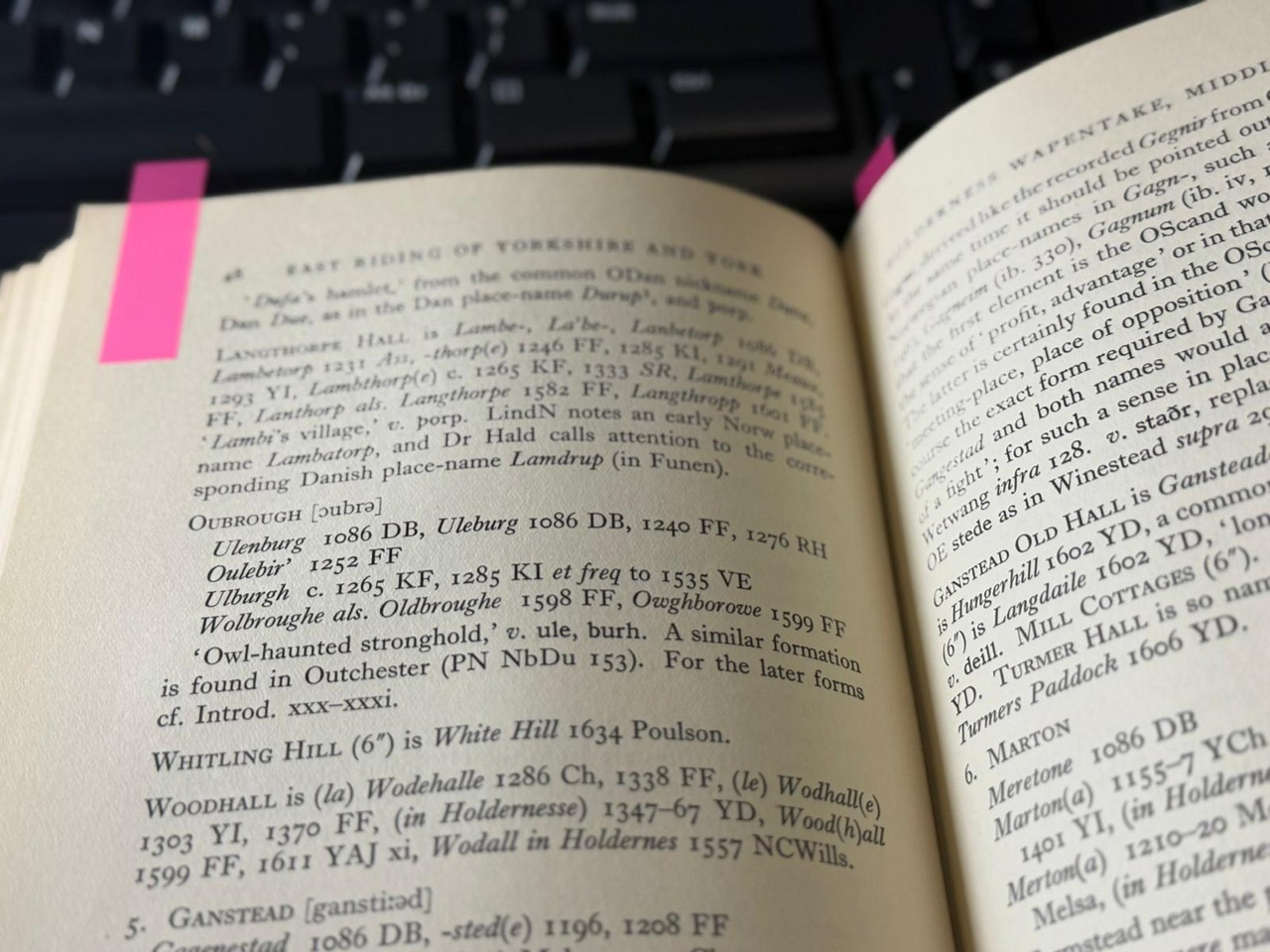
I was so enthused by Warren’s book and it’s themes that I bought an old copy of The Place-Names Of The East Riding Of Yorkshire And York.
This is one of dozens of volumes (91 at the time of writing) from the English Place-Name Society who have carried out a county-by-county survey of the place-names of England to discern their historic meanings.
The book – and others in the series – are fascinating in their own right, but what I wanted was to discover was if I had any places near my home that took their names from the birds, which Warren had so brilliantly explored in The Cuckoo’s Lea.
So, with a cup of tea (Yorkshire, decaf, for anyone interested) and a handful of pink Post-it notes to hand, I flicked through the entire book, marking any bird-related place names I could find.
It took a little while, but among the plethora of -thorpes (villages), -bys and -tons (farms), -wicks (dairy farms), and -hams (homesteads), there they were, nestled unassumingly: eight instances of ornithological place names.
Some names I were vaguely aware of, others I had passed several times, indeed, one was only a few miles from but my home, but until then, I had no idea they had any etymological links with birds.
I shall certainly be visiting these places in the future, to explore their surroundings and to give myself somewhere new to wander, photograph and write about.
For now, though, I note them below and simply imagine what it might have felt like to live near an “owl-haunted stronghold”; a presence so strong that it gave the place its name;
Oubrough – TA 15534 37008 - “Owl Haunted Stronghold”
Arnold – TA 12637 41443 - “Nook of land haunted by eagles”
Dotterel Inn – TA 13123 74632 - “named from the bird”
Dotterel Cottage – SE 95650 71350 - as above
Feather Holm – TA 07930 52030 - “a similar name is found in Denmark and it is thought that this name arose because great flocks of birds had lived in the neighbourhood”
Gowthorpe – SE 76387 54539 - “‘Gauk’s village’ or ‘cuckoo village’”
South Duffield – SE 68098 33445 North Duffield – SE 68380 37187 - “Tract of land frequented by doves”
It should be noted that the eight places listed above are only those described in the EPNS East Riding of Yorkshire volume. There are likely to be many dozens more place-names on the map that reference birds in one way or another.
For example, just six miles west of the Feather Holm noted above, there is Bustard Nest Farm, shown on modern Ordnance Survey maps and also on the six-inch maps of 1855. It seems likely that this, and many similar places, take their names from avian counterparts (like the Dotterel above), but that is a subject – and potentially several other blog posts – for another day.